Newest Post

16 Tips To Boost Your YouTube Marketing Strategy

| Sunday, 16 June 2013
Read more »

16 Tips to Boost Your YouTube Marketing Strategy

1. Have a meaningful channel name with target keywords. Use capitalization in the channel name so that it is clear. If you are starting a YouTube channel about cats, CuteCatsDaily is a better channel name than catschannel1987
2. Enter a title for the channel. By default your channel name is also the title of the channel but you can edit it in channel settings. Have your keywords in this channel for search optimization. Note that this channel title is in H1 tag – good for SEO.
3. Enter a link to your website in your channel. YouTube allows adding more than one link in your channel’s sidebar.
4. When uploading videos, enter the tags carefully. Enter low competition keywords. These keywords can be found out from AdWords Keyword tool. You can also enter tags from competing videos so that your videos will appear as related videos when those videos are watched.
5. If you are creating infomovies (videos with slides and voiceover) using PowerPoint or Keynote, make sure that you have a custom unique background for your slides. This custom background can contain your website’s URL on the top right corner or bottom right corner. With this technique you can gain visitors even if your video is embedded on other sites in which case your description and the link in it will not appear.
6. If you are making screencast videos, try to record the screen at 640×360 (16:9) so that the videos do not appear fuzzy. If you can’t do it in 360p, you can make it at 480p (854×480). Do not upload screencast videos in 720p unless you have no other option.
7. Use annotations in your video. Have a specific call to action in the annotation. You can link to subscribe page, channel page, another YouTube video or just ask the visitor to visit your URL for more information. Note that you can use only YouTube internal links in annotations, external linking is not allowed.
8. Make use of YouTube trends. You can create videos for your niche related to the trending videos and get a good number of eyeballs on your videos. VisitYouTube-trends.Blogspot.com (YouTube’s official blog) to see the latest trending videos.
9. Upload high quality videos consistently to keep your users engaged and YouTube happy.
10. Do not be too aggressive with marketing on YouTube. If you upload a sales video and wonder why it hasn’t gone viral, it is time to understand that YouTube is a content website. Deliver good content and then ask people to visit your website.
11. Try to get your face on the camera as much as possible. You can create talking head videos in a batch. Allot 1 or 2 days in a month for video creation and create 5-10 videos in 1 go. You may want to shoot those videos in different costume each time.
12. Do not upload 10 minute long videos. Attention span of users in YouTube is very low. In my experience 1-2 minute videos work best for YouTube. Deliver a short but powerful message. If you have something significant to say, break up the video into 2-5 parts and upload them with unique Keyword rich titles. This way you will get more viewers to your video and viewers can skip parts of your video if not interested. Make sure to link these parts of the video using annotations. However please keep in mind that this is recommended but not a rule. There are exceptions. I have 10-15 minute video going well on YouTube and a lot of others have too.
13. Controversial videos attract a lot of attention on YouTube. However make sure to provide some quality content after you attract the viewers using you controversial title.
14. Spend some time everyday on leaving useful comments in related videos. If your comments are liked, it will be on top and a lot of visitors will click on your username and land on your channel.
15. Every video you upload is eligible to be a video response to some video. Find some related videos in your niche and if appropriate, post a video response using one of your videos.
16. Have a separate Google account for your YouTube channel so that even if your account gets banned, your other services are not affected.

16 Tips To Boost Your YouTube Marketing Strategy

Posted by : Javed
Date :Sunday, 16 June 2013
With 0comments

Make Money Using BlogSpot

|
Read more »

Make Money Using BlogSpot

Money blogging is one of the sources of income over the internet. A lot of people making money online using blog either it is free or self hosted blog. You know very well that for doing money blogging you need own blog or site. There are so many platforms available on which you can start money free blog. Great things about these blog is that you don’t have to worry about domain name registration or any hosting service. These platforms are available with easy Content management system just you need to add number of article or product description for money blogging.

Today I am going to show you how to make money using BlogSpot or blogger. BlogSpot is free service by Google in which you can easily share thought to the world. Similar to BlogSpot there also other platforms also available like wordpress, tumblr, posterous, typepad, but all other are not good as compared to blogger. All other platforms are different from each other and they have limited feature.
Of course BlogSpot is free and you can do easily money blogging with it. Make money using BlogSpot now become easy and you can sign up easily by simple filling form. Over all BlogSpot have a lot of advantage. I will show you each and every advantage and tips in front of you, it’s your choice how you will take benefits of that.

Below are some proven strategies that help make money using BlogSpot.

Selling Advertising
Selling Advertising space is one of the best things in BlogSpot because BlogSpot have freedom to add Ads. If you have Google AdSense account than Google AdSense will earn for you by just adding AdSense widget to blogger blog. Even you can create blank space (Ads Here) for selling Advertising to others Advertiser and they will pad you depending upon you blog traffic. For selling Ads to advertiser depend on your blog traffic and rank in Google. Generally advertiser pays $4 or $5 per month, but if you are getting more than 10000 and Google rank is more than 2 After that you may get high income. You need to increase blog traffic that will help you increase your income online.
Sell products
You can sell product over BlogSpot blog by joining LinkShare affiliate network or any others. Choose your product on LinkShare and write complete product description for your targeted audios. Add simple links or affiliate product banner to your product descriptions.
Flipping BlogSpot Blog
Flipping blog is selling of your blog to someone else when blog get high visitor. Generally flipping BlogSpot blog cost is count on annual blog revenue. E.g. - if my BlogSpot blog is generating $150 per month that means $150*12=$1800 per year. So you BlogSpot Blog costs will be $1800. Well written blogs always have a lot of value in market. Flipping BlogSpot Blog is little difficult because it’s totally free for everyone to join.
Get more customers
BlogSpot blog can work amazing for increasing your customer. When you are dealing on large online business you can divert customer from you BlogSpot blog to your affiliate landing pages.
These are basic tips for Make Money Using BlogSpot and I am sure it will help you. Just you need to more readers and optimization of blogger blog.If you can optimize blog in SEO and SMO than there is no problem to make money using blogger.

Make Money Using BlogSpot

Posted by : Javed
Date :
With 0comments

5 Ways To Increase Alexa Traffic Rank Of Your Blog

|
Read more »

5 Ways to Increase Alexa Traffic Rank of Your Blog

Amazon’s alexa traffic rank of a website is a measure which indicates the amount and level of traffic to a website from people all over the world who have alexa toolbar installed. It represents how popular your website or blog is on the internet. Alexa Traffic Rank is used by advertisers to know about the traffic levels of your website and plays a big part in deciding the advertising cost. Hence, if you want to make money online from advertising or sponsorships on your blog, you must pay a lot of attention towards improving the alexa rank of your blog.

5 Simple Ways to Increase Alexa Traffic Rank

Higher the alexa traffic, higher is the traffic to your blog and more will be the advertising costs on your blog. These are some simple techniques to increase your alexa rank which I am going to share with you.
  • Alexa Toolbar :- Download the alexa toolbar and use it to visit your blog. Alexa ranking is based on the number of visitors to your blog having alexa toolbar installed. You generally visit your blog a number of times during a day. So why not utilise your visits to improve your rankings.
  • Search Engines :- You should try and get listed on as many number of search engines as possible. Try and get yourself listed on DMOZ directory which is widely used on the internet.
  • Write Reviews :- One more method to increase your alexa traffic rank is to get reviews for your blog. You can write them on your own or get them written by someone else. You can use top 500 or 1000 sites ranked by Alexa to generate reviews for your own blog.
  • SEO Forums and Blogs :- Try and participate in SEO forums and blogs available on the internet as these are most likely to use Alexa Toolbar. A lot webmaters are involved with SEO forums which can be a good source of traffic to your blog.
  • Keep Asiatic Audience In Mind :- Studies have shown that Asiatic countries like India and China have the most number of Alexa toolbars installed with the people. Hence traffic from these countries can help you to gain very high alexa traffic rank.


5 Ways To Increase Alexa Traffic Rank Of Your Blog

Posted by : Javed
Date :
With 0comments

HOW TO MAKE MONEY IN FOREX

|
Read more »

HOW TO MAKE MONEY IN FOREX

How to make money in Forex?
The question has a broad range of answers.  First, you need to ask yourself, “Why am I interested in Forex”? In other words, what’s your objective?
Possible answers:
  1. I want to get rich so quick. This is NOT Forex. Forex Trading involves a high risk of loss, especially for new market entrants like you. How do I get disciplined and be ready for Forex?
    1. Understand that there is nothing in the world that grants easy money. And if it exists, No one would tell you its secrets. There however exist businesses that have higher rewards/risks. Forex is one of these!
    2. Read more. Visit our Forex Articles section; there are plenty of beginner’s articles.

    3. Subscribe in Forex forums. See what people are saying about their trades. 
      1. Attend some Forex training sessions
      2. Buy Forex books. Buy the beginner’s ones, don’t rush to the advanced level before understanding the basics (Below, we will give you some beginner tips)
    1. I want to work from home. This is a good reason. However, DON’T step into Forex and think of leaving your fulltime job before you really master it. This won’t take less than 12-18 months. I know this might be a long period from your point of view, but this is a short period from my perception which is based on 8 years of trading. Read (a-e) above. These apply for you too.
    2. I like the high leverage involved. I could double my money in a matter of hours. That’s a gambler’s perception. Well, if you want to Forex Bet, you are welcome. But don’t think of steady incomes, its like the casino, you can lose 10 times in a row when you bet for the color “red” in the roulette although the probability is 50%, and vice versa. Even if you made a killing in the beginning, you will lose it faster than you imagine.
    3. I have a steady income, but I want to increase it. That’s a great answer
    4. I have some money to invest. That’s a great answer
  2. Now, how to make money in Forex?
    1. Open a Demo account with any of the Forex Brokers of your choice.
    2. Understand the following :
      1. What is a pip? It’s the smallest unit of measuring changes in the values of a currency.
      2. What is a bid and asking price of currency pairs? One is used for buying and the other for selling
      3. Why are the bid and asking prices different? The difference between them is called the SPREAD. This is what the Forex Broker gains when you trade (buy or sell)
      4. What is a limit? It’s the pip that at which, you would like to TAKE PROFIT.
      5. What is a stop loss? It’s the pip that at which, you would like to STOP LOSING any further.
      6. How to open a trade? Decide if it’s a buy or a sell trade, and then click on the left side of the currency pair box for selling or right side for buying.
      7. How to close a trade? In your Opened positions tab, right click on the trade, and choose close position. A pop-up window will appear to confirm, click OK or YES.
      8. What is an order? It’s a buy/sell order that you give to the trading platform to perform at a CERTAIN UPCOMING/PROJECTED price.
    Is this How to make money in Forex? NOT YET, be patient, read more below
    1. Start using charts. Open any free Forex Charts provider, and choose the currency pair you wish to see. What do you realize?
      1. A chart appears with a lot of Forex Candlesticks. (Don’t start reading about Candlesticks until you’re finished reading this article)
      2. Zoom in, you will see that each bar/candle represent a single price action in a defined time-frame. You can change this time frame to look at different price histories for this currency pair.
      3. Try to understand the Chart Pattern, and decide if you will trade with the pattern or use a Forex Indicator to signal a reversal
      4. Once you’ve identified a trade, don’t place it until you identify your Stop Loss. This is more important than the trade itself. NEVER leave your trades floating! This is a big mistake that all forex traders fall within.
    Now, that you know How To Make Money in Forex, start trading WISELY and don’t rush. We are here to help you unbiased. So feel free to ask any questions before you shoot for anything new to you.
    We will be updating this article with newer ideas on a regular basis.
    The Best Forex Broker

HOW TO MAKE MONEY IN FOREX

Posted by : Javed
Date :
With 0comments

How To Increase Blog Traffic

|
Read more »

How to Increase Blog Traffic

It's easy to build a blog, but hard to build a successful blog with significant traffic. Over the years, we've grown the Moz blogto nearly a million visits each month and helped lots of other blogs, too. I launched a personal blog late last year and was amazed to see how quickly it gained thousands of visits to each post. There's an art to increasing a blog's traffic, and given that we seem to have stumbled on some of that knowledge, I felt it compulsory to give back by sharing what we've observed.
NOTE: This post replaces a popular one I wrote on the same topic in 2009. This post is intended to be useful to all forms of bloggers - independent folks, those seeking to monetize, and marketing professionals working an in-houseblog from tiny startups to huge companies. Not all of the tactics will work for everyone, but at least some of these should be applicable and useful.

1 - Target Your Content to an Audience Likely to Share

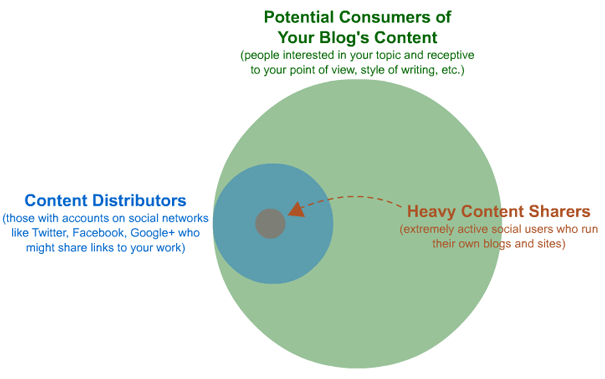
When strategizing about who you're writing for, consider that audience's ability to help spread the word. Some readers will naturally be more or less active in evangelizing the work you do, but particular communities, topics, writing styles and content types regularly play better than others on the web. For example, great infographics that strike a chord , beautiful videos that tell a story  and remarkable collections of facts that challenge common assumptions  are all targeted at audiences likely to share (geeks with facial hair, those interested in weight loss and those with political thoughts about macroeconomics respectively).

concentrations of the blue and orange circles in the diagram above, you dramatically improve the chances of reaching larger audiences and growing your traffic numbers. Targeting blog content at less-share-likely groups may not be a terrible decision (particularly if that's where you passion or your target audience lies), but it will decrease the propensity for your blog's work to spread like wildfire across the web.

2 - Participate in the Communities Where Your Audience Already Gathers

Advertisers on Madison Avenue have spent billions researching and determining where consumers with various characteristics gather and what they spend their time doing so they can better target their messages. They do it because reaching a group of 65+ year old women with commercials for extreme sports equipment is known to be a waste of money, while reaching an 18-30 year old male demographic that attends rock-climbing gyms is likely to have a much higher ROI.
Thankfully, you don't need to spend a dime to figure out where a large portion of your audience can be found on the web. In fact, you probably already know a few blogs, forums, websites and social media communities where discussions and content are being posted on your topic (and if you don't a Google search will take you much of the way). From that list, you can do some easy expansion using a web-based tool like Double Click's Ad Planner:

determined the communities where your soon-to-be-readers gather, you can start participating. Create an account, read what others have written and don't jump in the conversation until you've got a good feel for what's appropriate and what's not. I've written a post here about rules for comment marketing, and all of them apply. Be a good web citizen and you'll be rewarded with traffic, trust and fans. Link-drop, spam or troll and you'll get a quick boot, or worse, a reputation as a blogger no one wants to associate with.

3 - Make Your Blog's Content SEO-Friendly

Search engines are a massive opportunity for traffic, yet many bloggers ignore this channel for a variety of reasons that usually have more to do with fear and misunderstanding than true problems. As I've written before, "SEO, when done right, should never interfere with great writing." In 2011, Google received over 3 billion daily searches from around the world, and that number is only growing:

sources: Comscore + Google
Taking advantage of this massive traffic opportunity is of tremendous value to bloggers, who often find that much of the business side of blogging, from inquiries for advertising to guest posting opportunities to press and discovery by major media entities comes via search.
SEO for blogs is both simple and easy to set up, particularly if you're using an SEO-friendly platform like Wordpress, Drupal or Joomla. For more information on how to execute on great SEO for blogs, check out the following resources:
  • Blogger's Guide to SEO (from SEOBook)
  • The Beginner's Guide to SEO (from Moz)
  • Wordpress Blog SEO Tutorial (from Yoast)
  • SEO for Travel Bloggers (but applicable to nearly any type of blog - from Moz)
Don't let bad press or poor experiences with spammers (spam is not SEO) taint the amazing power and valuable contributions SEO can make to your blog's traffic and overall success. 20% of the effort and tactics to make your content optimized for search engines will yield 80% of the value possible; embrace it and thousands of visitors seeking exactly what you've posted will be the reward.

4 - Use Twitter, Facebook and Google+ to Share Your Posts & Find New Connections

Twitter just topped 465 million registered accounts. Facebook has over 850 million active users. Google+ has nearly 100 million. LinkedIn is over 130 million. Together, these networks are attracting vast amounts of time and interest from Internet users around the world, and those that participate on these services fit into the "content distributors" description above, meaning they're likely to help spread the word about your blog.
Leveraging these networks to attract traffic requires patience, study, attention to changes by the social sites and consideration in what content to share and how to do it. My advice is to use the following process:
  • If you haven't already, register a personal account and a brand account at each of the following - Twitter, Facebook, Google+ and LinkedIn (those links will take you directly to the registration pages for brand pages). For example, my friend Dharmesh has a personal account for Twitter and a brand account for OnStartups (one of his blog projects). He also maintains brand pages on Facebook, LinkedIn and Google+.
  • Fill out each of those profiles to the fullest possible extent - use photos, write compelling descriptions and make each one as useful and credible as possible. Research shows that profiles with more information have a significant correlation with more successful accounts (and there's a lot of common sense here, too, given that spammy profiles frequently feature little to no profile work).
  • Connect with users on those sites with whom you already share a personal or professional relationships, and start following industry luminaries, influencers and connectors. Services like FollowerWonk and FindPeopleonPlus can be incredible for this:

  • Start sharing content - your own blog posts, those of peers in your industry who've impressed you and anything that you feel has a chance to go "viral" and earn sharing from others.
  • Interact with the community - use hash tags, searches and those you follow to find interesting conversations and content and jump in! Social networks are amazing environment for building a brand, familiarizing yourself with a topic and the people around it, and earning the trust of others through high quality, authentic participation and sharing
If you consistently employ a strategy of participation, share great stuff and make a positive, memorable impression on those who see your interactions on these sites, your followers and fans will grow and your ability to drive traffic back to your blog by sharing content will be tremendous. For many bloggers, social media is the single largest source of traffic, particularly in the early months after launch, when SEO is a less consistent driver.

5 - Install Analytics and Pay Attention to the Results

At the very least, I'd recommend most bloggers install Google Analytics (which is free), and watch to see where visits originate, which sources drive quality traffic and what others might be saying about you and your content when they link over. If you want to get more advanced, check out this post on 18 Steps to Successful Metrics and Marketing.
Here's a screenshot from the analytics of my wife's travel blog, the Everywhereist:

As you can see, there's all sorts of great insights to be gleaned by looking at where visits originate, analyzing how they were earned and trying to repeat the successes, focus on the high quality and high traffic sources and put less effort into marketing paths that may not be effective. In this example, it's pretty clear that Facebook and Twitter are both excellent channels. StumbleUpon sends a lot of traffic, but they don't stay very long (averaging only 36 seconds vs. the general average of 4 minutes!).
Employing analytics is critical to knowing where you're succeeding, and where you have more opportunity. Don't ignore it, or you'll be doomed to never learn from mistakes or execute on potential.

6 - Add Graphics, Photos and Illustrations (with link-back licensing)

If you're someone who can produce graphics, take photos, illustrate or even just create funny doodles in MS Paint, you should leverage that talent on your blog. By uploading and hosting images (or using a third-party service like Flickrto embed your images with licensing requirements on that site), you create another traffic source for yourself via Image Search, and often massively improve the engagement and enjoyment of your visitors.
When using images, I highly recommend creating a way for others to use them on their own sites legally and with permission, but in such a way that benefits you as the content creator. For example, you could have a consistent notice under your images indicating that re-using is fine, but that those who do should link back to this post. You can also post that as a sidebar link, include it in your terms of use, or note it however you think will get the most adoption.
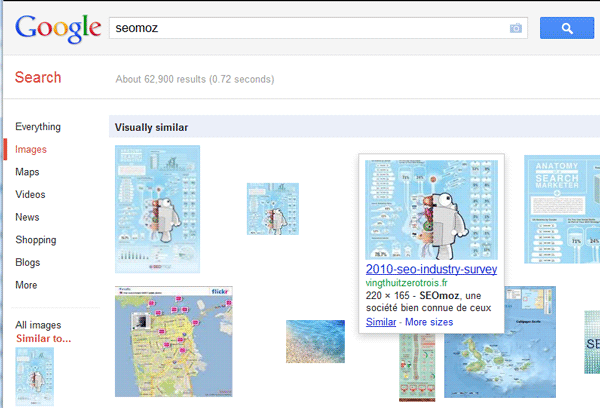
Some people will use your images without linking back, which sucks. However, you can find them by employing the Image Search function of "similar images," shown below:

Clicking the "similar" link on any given image will show you other images that Google thinks look alike, which can often uncover new sources of traffic. Just reach out and ask if you can get a link, nicely. Much of the time, you'll not only get your link, but make a valuable contact or new friend, too!

7 - Conduct Keyword Research While Writing Your Posts

Not surprisingly, a big part of showing up in search engines is targeting the terms and phrases your audience are actually typing into a search engine. It's hard to know what these words will be unless you do some research, and luckily, there's a free tool from Google to help called the AdWords Keyword Tool.
Type some words at the top, hit search and AdWords will show you phrases that match the intent and/or terms you've employed. There's lots to play around with here, but watch out in particular for the "match types" options I've highlighted below:

When you choose "exact match" Ad-words will show you only the quantity of searches estimated for that precise phrase. If you use broad match, they'll include any search phrases that use related/similar words in a pattern they think could have overlap with your keyword intent (which can get pretty darn broad). "Phrase match" will give you only those phrases that include the word or words in your search - still fairly wide-ranging, but between "exact" and "broad."
When you're writing a blog post, keyword research is best utilized for the title and headline of the post. For example, if I wanted to write a post here on Moz about how to generate good ideas for bloggers, I might craft something that uses the phrase "blog post ideas" or "blogging ideas" near the front of my title and headline, as in "Blog Post Ideas for When You're Truly Stuck," or "Blogging Ideas that Will Help You Clear Writer's Block."
Optimizing a post to target a specific keyword isn't nearly as hard as it sounds. 80% of the value comes from merely using the phrase effectively in the title of the blog post, and writing high quality content about the subject. If you're interested in more, read Perfecting Keyword Targeting and On-Page Optimization (a slightly older resource, but just as relevant today as when it was written).

8 - Frequently Reference Your Own Posts and Those of Others

The web was not made for static, text-only content! Readers appreciate links, as do other bloggers, site owners and even search engines. When you reference your own material in-context and in a way that's not manipulative (watch out for over-optimizing by linking to a category, post or page every time a phrase is used - this is almost certainly discounted by search engines and looks terrible to those who want to read your posts), you potentially draw visitors to your other content AND give search engines a nice signal about those previous posts.
Perhaps even more valuable is referencing the content of others. The biblical expression "give and ye shall receive," perfectly applies on the web. Other site owners will often receive Google Alerts or look through their incoming referrers (as I showed above in tip #5) to see who's talking about them and what they're saying. Linking out is a direct line to earning links, social mentions, friendly emails and new relationships with those you reference. In its early days, this tactic was one of the best ways we earned recognition and traffic with the SEOmoz blog and the power continues to this day.

9 - Participate in Social Sharing Communities Like Reddit + StumbleUpon

The major social networking sites aren't alone in their power to send traffic to a blog. Social community sites like Reddit (which now receives more than 2 billion! with a "B"! views each month), StumbleUpon, Pinterest, Tumblr, Care2(for nonprofits and causes), GoodReads (books), Ravelry (knitting), Newsvine (news/politics) and many, many more (Wikipedia maintains a decent, though not comprehensive.
Each of these sites have different rules, formats and ways of participating and sharing content. As with participation in blog or forum communities described above in tactic #2, you need to add value to these communities to see value back. Simply drive-by spamming or leaving your link won't get you very far, and could even cause a backlash. Instead, learn the ropes, engage authentically and you'll find that fans, links and traffic can develop.
These communities are also excellent sources of inspiration for posts on your blog. By observing what performs well and earns recognition, you can tailor your content to meet those guidelines and reap the rewards in visits and awareness. My top recommendation for most bloggers is to at least check whether there's an appropriate subreddit in which you should be participating.Subreddits and their search function can help with that.

10 - Guest Blog (and Accept the Guest Posts of Others)

When you're first starting out, it can be tough to convince other bloggers to allow you to post on their sites OR have an audience large enough to inspire others to want to contribute to your site. This is when friends and professional connections are critical. When you don't have a compelling marketing message, leverage your relationships - find the folks who know you, like you and trust you and ask those who have blog to let you take a shot at authoring something, then ask them to return the favor.
Guest blogging is a fantastic way to spread your brand to new folks who've never seen your work before, and it can be useful in earning early links and references back to your site, which will drive direct traffic and help your search rankings (diverse, external links are a key part of how search engines rank sites and pages). Several recommendations for those who engage in guest blogging:
  • Find sites that have a relevant audience - it sucks to pour your time into writing a post, only to see it fizzle because the readers weren't interested. Spend a bit more time researching the posts that succeed on your target site, the makeup of the audience, what types of comments they leave and you'll earn a much higher return with each post.
  • Don't be discouraged if you ask and get a "no" or a "no response." As your profile grows in your niche, you'll have more opportunities, requests and an easier time getting a "yes," so don't take early rejections too hard and watch out - in many marketing practices, persistence pays, but pestering a blogger to write for them is not one of these (and may get your email address permanently banned from their inbox).
  • When pitching your guest post make it as easy as possible for the other party. When requesting to post, have a phenomenal piece of writing all set to publish that's never been shared before and give them the ability to read it. These requests get far more "yes" replies than asking for the chance to write with no evidence of what you'll contribute. At the very least, make an outline and write a title + snippet.
  • Likewise, when requesting a contribution, especially from someone with a significant industry profile, asking for a very specific piece of writing is much easier than getting them to write an entire piece from scratch of their own design. You should also present statistics that highlight the value of posting on your site - traffic data, social followers, RSS subscribers, etc. can all be very persuasive to a skeptical writer.
A great tool for frequent guest bloggers is Ann Smarty's MyBlogGuest, which offers the ability to connect writers with those seeking guest contributions (and the reverse).

Twitter, Facebook, LinkedIn and Google+ are also great places to find guest blogging opportunities. In particular, check out the profiles of those you're connected with to see if they run blogs of their own that might be a good fit.Google's Blog Search function and Google Reader's Search are also solid tools for discovery.

11 - Incorporate Great Design Into Your Site

The power of beautiful, usable, professional design can't be overstated. When readers look at a blog, the first thing they judge is how it "feels" from a design and UX perspective. Sites that use default templates or have horrifying, 1990's design will receive less trust, a lower time-on-page, fewer pages per visit and a lower likelihood of being shared. Those that feature stunning design that clearly indicates quality work will experience the reverse - and reap amazing benefits.

These threads -1, 2, 3 and4 - feature some remarkable blog designs for inspiration
If you're looking for a designer to help upgrade the quality of your blog, there's a few resources I recommend:
  • Dribbble - great for finding high quality professional designers
  • Forrst - another excellent design profile community
  • Behance - featuring galleries from a wide range of visual professionals
  • Sortfolio - an awesome tool to ID designers by region, skill and budget
  • 99 Designs - a controversial site that provides designs on spec via contests (I have mixed feelings on this one, but many people find it useful, particularly for budget-conscious projects)
This is one area where budgeting a couple thousand dollars (if you can afford it) or even a few hundred (if you're low on cash) can make a big difference in the traffic, sharing and viral-impact of every post you write.

12 - Interact on Other Blogs' Comments

As bloggers, we see a lot of comments. Many are spam, only a few add real value, and even fewer are truly fascinating and remarkable. If you can be in this final category consistently, in ways that make a blogger sit up and think "man, I wish that person commented here more often!" you can achieve great things for your own site's visibility through participation in the comments of other blogs.
Combine the tools presented in #10 (particularly Google Reader/Blog Search) and #4 (especially FollowerWonk) for discovery. The feed subscriber counts in Google Reader can be particularly helpful for identifying good blogs for participation. Then apply the principles covered in this post on comment marketing.


Do be conscious of the name you use when commenting and the URL(s) you point back to. Consistency matters, particularly on naming, and linking to internal pages or using a name that's clearly made for keyword-spamming rather than true conversation will kill your efforts before they begin.


13 - Participate in Q+A Sites

Every day, thousands of people ask questions on the web. Popular services like Yahoo! Answers, Answers.com, Quora, StackExchange, Formspring and more serve those hungry for information whose web searches couldn't track down the responses they needed.
The best strategy I've seen for engaging on Q+A sites isn't to answer every question that comes along, but rather, to strategically provide high value to a Q+A community by engaging in those places where:
  • The question quality is high, and responses thus far have been thin
  • The question receives high visibility (either by ranking well for search queries, being featured on the site or getting social traffic/referrals). Most of the Q+A sites will show some stats around the traffic of a question
  • The question is something you can answer in a way that provides remarkable value to anyone who's curious and drops by
I also find great value in answering a few questions in-depth by producing an actual blog post to tackle them, then linking back. This is also a way I personally find blog post topics - if people are interested in the answer on a Q+A site, chances are good that lots of folks would want to read it on my blog, too!
Just be authentic in your answer, particularly if you're linking. If you'd like to see some examples, I answer a lot of questions at Quora, frequently include relevant links, but am rarely accused of spamming or link dropping because it's clearly about providing relevant value, not just getting a link for SEO (links on most user-contributed sites are "nofollow" anyway, meaning they shouldn't pass search-engine value). There's a dangerous line to walk here, but if you do so with tact and candor, you can earn a great audience from your participation.

14 - Enable Subscriptions via Feed + Email (and track them!)

If someone drops by your site, has a good experience and thinks "I should come back here and check this out again when they have more posts," chances are pretty high (I'd estimate 90%+) that you'll never see them again. That sucks! It shouldn't be the case, but we have busy lives and the Internet's filled with animated gifs of cats.
In order to pull back some of these would-be fans, I highly recommend creating an RSS feed using Feedburner and putting visible buttons on the sidebar, top or bottom of your blog posts encouraging those who enjoy your content to sign up (either via feed, or via email, both of which are popular options).

If you're using Wordpress, there's some easy plugins for this, too.
Once you've set things up, visit every few weeks and check on your subscribers - are they clicking on posts? If so, which ones? Learning what plays well for those who subscribe to your content can help make you a better blogger, and earn more visits from RSS, too.

15 - Attend and Host Events

Despite the immense power of the web to connect us all regardless of geography, in-person meetings are still remarkably useful for bloggers seeking to grow their traffic and influence. The people you meet and connect with in real-world settings are far more likely to naturally lead to discussions about your blog and ways you can help each other. This yields guest posts, links, tweets, shares, blogroll inclusion and general business development like nothing else.

I'm a big advocate of Lanyrd, an event directory service that connects with your social networks to see who among your contacts will be at which events in which geographies. This can be phenomenally useful for identifying which meetups, conferences or gatherings are worth attending (and who you can carpool with). The founder of Lanyrd also contributed this great answer on Quora about other search engines/directories for events (which makes me like them even more).

16 - Use Your Email Connections (and Signature) to Promote Your Blog

As a blogger, you're likely to be sending a lot of email out to others who use the web and have the power to help spread your work. Make sure you're not ignoring email as a channel, one-to-one though it may be. When given an opportunity in a conversation that's relevant, feel free to bring up your blog, a specific post or a topic you've written about. I find myself using blogging as a way to scalably answer questions - if I receive the same question many times, I'll try to make a blog post that answers it so I can simply link to that in the future.

I also like to use my email signature to promote the content I share online. If I was really sharp, I'd do link tracking using a service like Bit.ly so I could see how many clicks email footers really earn. I suspect it's not high, but it's also not 0.

17 - Survey Your Readers

Web surveys are easy to run and often produce high engagement and great topics for conversation. If there's a subject or discussion that's particularly contested, or where you suspect showing the distribution of beliefs, usage or opinions can be revealing, check out a tool like SurveyMonkey (they have a small free version) or PollDaddy. Google Docs also offers a survey tool that's totally free, but not yet great in my view.

18 - Add Value to a Popular Conversation

Numerous niches in the blogosphere have a few "big sites" where key issues arise, get discussed and spawn conversations on other blogs and sites. Getting into the fray can be a great way to present your point-of-view, earn attention from those interested in the discussion and potentially get links and traffic from the industry leaders as part of the process.
You can see me trying this out with Fred Wilson's AVC blog last year (an incredibly popular and well-respected blog in the VC world). Fred wrote a post about Marketing that I disagreed with strongly and publicly and a day later, hewrote a follow-up where he included a graphic I made AND a link to my post.
If you're seeking sources to find these "popular conversations," Alltop, Topsy,Techmeme (in the tech world) and their sister sites MediaGazer, Memeorandumand WeSmirch, as well as PopURLs can all be useful.

19 - Aggregate the Best of Your Niche

Bloggers, publishers and site owners of every variety in the web world love and hate to be compared and ranked against one another. It incites endless intrigue, discussion, methodology arguments and competitive behavior - but, it's amazing for earning attention. When a blogger publishes a list of "the best X" or "the top X" in their field, most everyone who's ranked highly praises the list, shares it and links to it. Here's an example from the world of marketing itself:

That's a screenshot of the AdAge Power 150, a list that's been maintained for years in the marketing world and receives an endless amount of discussion by those listed (and not listed). For example, why is SEOmoz's Twitter score only a "13" when we have so many more followers, interactions and retweets than many of those with higher scores? Who knows. But I know it's good for AdAge. :-)
Now, obviously, I would encourage anyone building something like this to be as transparent, accurate and authentic as possible. A high quality resource that lists a "best and brightest" in your niche - be they blogs, Twitter accounts, Facebook pages, individual posts, people, conferences or whatever else you can think to rank - is an excellent piece of content for earning traffic and becoming a known quantity in your field.
Oh, and once you do produce it - make sure to let those featured know they've been listed. Tweeting at them with a link is a good way to do this, but if you have email addresses, by all means, reach out. It can often be the start of a great relationship!

20 - Connect Your Web Profiles and Content to Your Blog

Many of you likely have profiles on services like YouTube, Slideshare, Yahoo!, DeviantArt and dozens of other social and Web 1.0 sites. You might be uploading content to Flickr, to Facebook, to Picasa or even something more esoteric like Prezi. Whatever you're producing on the web and wherever you're doing it, tie it back to your blog.
Including your blog's link on your actual profile pages is among the most obvious, but it's also incredibly valuable. On any service where interaction takes place, those interested in who you are and what you have to share will follow those links, and if they lead back to your blog, they become opportunities for capturing a loyal visitor or earning a share (or both!). But don't just do this with profiles - do it with content, too! If you've created a video for YouTube, make your blog's URL appear at the start or end of the video. Include it in the description of the video and on the uploading profile's page. If you're sharing photos on any of the dozens of photo services, use a watermark or even just some text with your domain name so interested users can find you.
If you're having trouble finding and updating all those old profiles (or figuring out where you might want to create/share some new ones), KnowEm is a great tool for discovering your own profiles (by searching for your name or pseudonyms you've used) and claiming profiles on sites you may not yet have participated in.
I'd also strongly recommend leveraging Google's relatively new protocol for rel=author. AJ Kohn wrote a great post on how to set it up here, and Yoast has another good one on building it into Wordpress sites. The benefit for bloggers who do build large enough audiences to gain Google's trust is earning your profile photo next to all the content you author - a powerful markup advantage that likely drives extra clicks from the search results and creates great, memorable branding, too.

21 - Uncover the Links of Your Fellow Bloggers (and Nab 'em!)

If other blogs in your niche have earned references from sites around the web, there's a decent chance that they'll link to you as well. Conducting competitive link research can also show you what content from your competition has performed well and the strategies they may be using to market their work. To uncover these links, you'll need to use some tools.
Open SiteExplorer is my favorite, but I'm biased (it's made by Moz). However, it is free to use - if you create a registered account here, you can get unlimited use of the tool showing up to 1,000 links per page or site in perpetuity.

There are other good tools for link research as well, including Blekko,Majestic,Ahrefs and, I've heard that in the near-future,SearchMetrics.
Finding a link is great, but it's through the exhaustive research of looking through dozens or hundreds that you can identify patterns and strategies. You're also likely to find a lot of guest blogging opportunities and other chances for outreach. If you maintain a great persona and brand in your niche, your ability to earn these will rise dramatically.

Bonus #22 - Be Consistent and Don't Give Up

If there's one piece of advice I wish I could share with every blogger, it's this:


The above image comes from Everywhereist's analytics. Geraldine could have given up 18 months into her daily blogging. After all, she was putting in 3-5 hours each day writing content, taking photos, visiting sites, coming up with topics, trying to guest blog and grow her Twitter followers and never doing any SEO (don't ask, it's a running joke between us). And then, almost two years after her blog began, and more than 500 posts in, things finally got going. She got some nice guest blogging gigs, had some posts of hers go "hot" in the social sphere, earned mentions on some bigger sites, then got really big press from Time's Best Blogs of 2011.
I'd guess there's hundreds of new bloggers on the web each day who have all the opportunity Geraldine had, but after months (maybe only weeks) of slogging away, they give up.
When I started the SEOmoz blog in 2004, I had some advantages (mostly a good deal of marketing and SEO knowledge), but it was nearly 2 years before the blog could be called anything like a success. Earning traffic isn't rocket science, but it does take time, perseverance and consistency. Don't give up. Stick to your schedule. Remember that everyone has a few posts that suck, and it's only by writing and publishing those sucky posts that you get into the habit necessary to eventually transform your blog into something remarkable.
Good luck and good blogging from all of us at Moz!

Source: www.earning-formula.blogspot.com|

How To Increase Blog Traffic

Posted by : Javed
Date :
With 0comments

Taking Negative Comments Positively

|
Read more »

Taking Negative comments Positively


Lets face it, when we are talking about something and people oppose us none of us really like the guy opposing us and we call him names like moron or something similar (sometimes worse) When someone disagrees with our line of thoughts and is quite open about it ( sometimes way to open and even outrageous ) we really dont take it in a good spirits always, do we ?

I once read somewhere something on the lines of - when someone opposes you consider it as positive sign that you are on the right track !!

Talking about blogs and comments they have been together since the beginning of this world and are kinda inseparable. You must have seen a lot of blogposts with negative comments and readers disapproving of what the author has written but there are a lot of blogger who simply delete such comments almost instantly like they were waiting for this very moment and learn from it.

So how does negative comments help us and how can we take it in a more positive way or lets say in good spirits is what we will be discussing today.

New and Different Point of View

When someone disagrees with your thoughts they are usually based on some observation and thinking and most readers are kind enough to present their side of the story and thoughts in the comments. So now you have a new point of view to ponder over. Maybe they are right and you are wrong or vice versa but both of you should take it in a healthy way. If you are wrong then accept it - you wont get hurt. And if you are right and then try to convince them further with more details - they wont bite you for opposing.

So it is really the beginning of a healthy relationship between you and your reader and helps you improve your writing skills as well. Remember that each and every visitor is equally important.

Increases Involvement

Thats so true. When someone disagrees with your line of thoughts that means he has gone through the trouble of reading your post carefully and and has done his homework - its a positive sign that atleast there is one reader that is following up on your posts. It also increases involvement of other readers who start taking interest in the conversation and try to evaluate both of you trying to understand who is perhaps more correct in his approach.

It also increases your traffic :twisted:

Controversies increases publicity but fruits are short lived

Though it may sound like a good idea to purposefully create such posts and write up stories that are controversial and questionable just reap the benefits of more attention of other bloggers in the related community but many us forget that such traffic and attention is often short lived. Soon readers realize the story behind the scenes and frown upon such bloggers thinking that all he can do write crabs and take names providing no value to the community. There are alot of examples of such infamous personalities in Hollywood who are not doing anything good but still make it to the front page when they attend some party where no one can stand on properly !!

Taking Negative Comments Positively

Posted by : Javed
Date :
With 0comments
Next → ← Prev
▲Top▲